

Last Updated: June 22, 2026
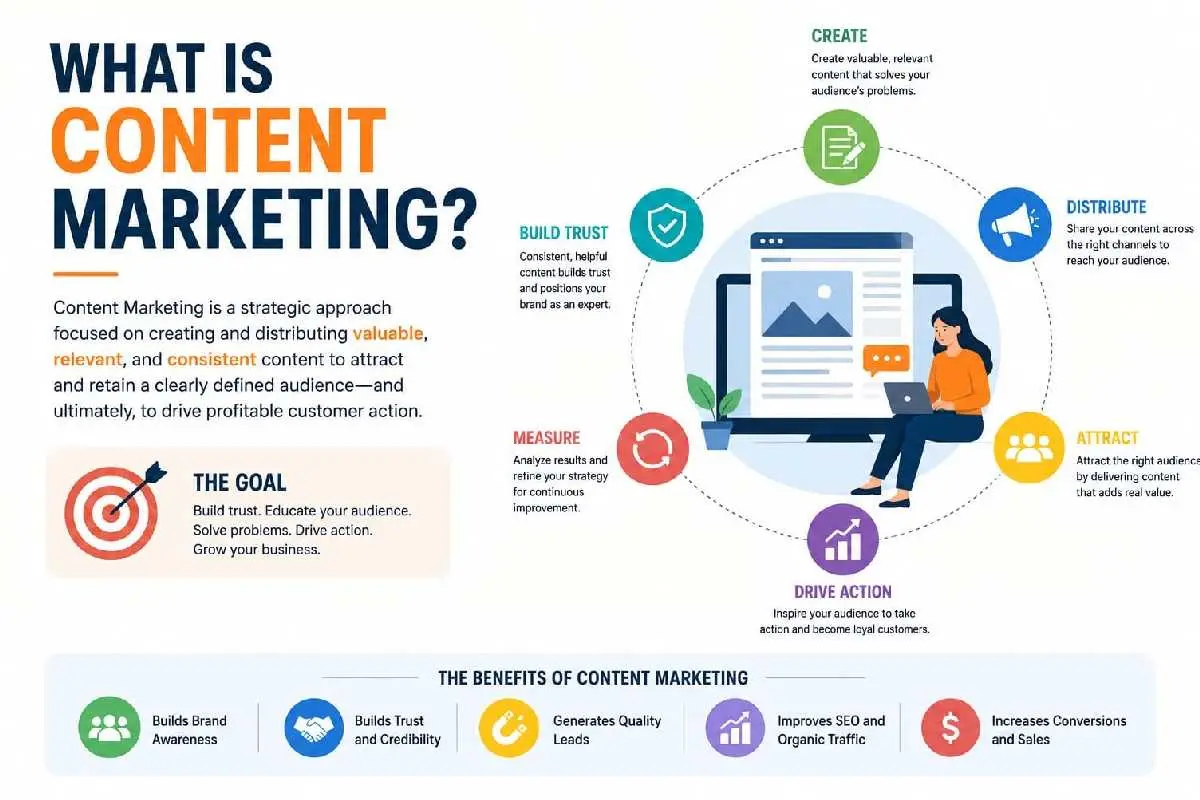
Content marketing refers to a marketing technique that entails the development and dissemination of valuable and relevant information to attract and maintain a clearly defined target market. Content marketing does not involve promoting your product but instead assists you in educating prospective customers and gaining their trust.
It is amongst the best ways that you can use for marketing in 2026 when creating websites, optimizing the SEO rating, building authority, and generating organic traffic. No matter whether you have started a new company or are even working on a large enterprise scale, there is a need for you to acquaint yourself with the concept of content advertising.
What is Content Marketing and Why Does It Matter?
Content marketing refers to the process involved in generating content that answers the questions of people and solves their problems. There are various types of content you should create when looking forward to reaching out to your targeted audience.
While traditional marketing focuses on selling products and services, content marketing focuses on building connections prior to conducting sales.
Why is Content Marketing necessary up to 2026?
Content marketing will remain very vital up to 2026 since the majority of consumers depend on the search results powered by artificial intelligence when making decisions on purchasing products and services.
- Improves organic search visibility
- Builds brand credibility and authority
- Generates qualified leads
- Supports social media marketing efforts
- Increases customer engagement
- Reduces customer acquisition costs
- Improves conversion rates over time
Key Components of a Successful Content Marketing Strategy
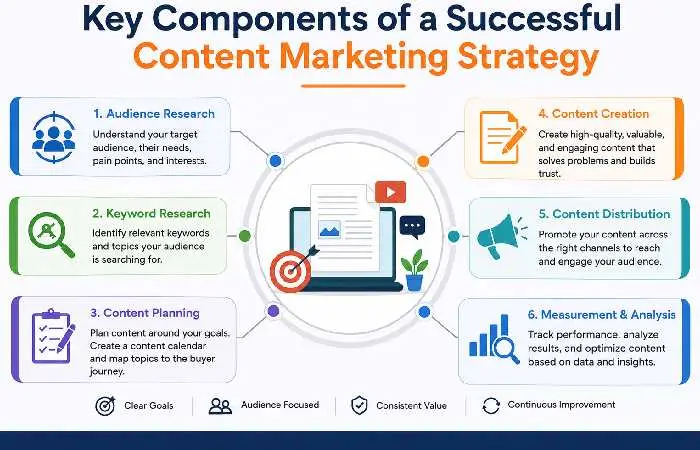
Actual deployment of content marketing needs to set clear objectives and understand the target audience very well. It further requires carrying out keyword analysis, creating quality content, distributing the content, and measuring the effectiveness of the content continuously. In so doing, businesses will be able to influence their target clients and convert them into clients.
1. Audience Research
Considering your target audience is the basis of effective content marketing.
Identify:
- Customer pain points
- Search behavior
- Purchase motivations
- Frequently asked questions
2. Keyword Research
SEO-driven content starts with identifying keywords your spectators actively search for.
Examples:
- What is content marketing
- Content marketing strategy
- Content marketing examples
- Benefits of content marketing
- Content marketing services
3. Content Planning
Create a content calendar cover:
- Awareness-stage content
- Consideration-stage content
- Decision-stage content
4. Content Creation
Focus on producing:
- Original insights
- Practical examples
- Data-backed recommendations
- Expert opinions
5. Distribution
Promote content through:
- Organic search
- Email marketing
- Social media
- Industry communities
- Outreach campaigns
6. Presentation Measurement
Path metrics such as:
- Organic traffic
- Keyword rankings
- Leads generated
- Conversion rates
- Engagement metrics.
Types of Content Used in Digital Marketing
Different types of content are utilized in digital marketing, with each type having its unique objective. Examples of such content include blog entries, videos, social media entries, infographics, emails, case studies, podcasts, and e-books, among other types. Employing various types of content has many benefits for companies in extending their reach.
Blog Articles
The most common content type for SEO and organic traffic generation.
Benefits:
- Rank for target keywords
- Build topical authority
- Educate audiences
Videos
Video content continues to dominate online engagement.
Benefits:
- Higher engagement rates
- Improved retention
- Strong social sharing potential
Case Studies
Showcase real customer success stories.
Benefits:
- Builds trust
- Demonstrates expertise
- Supports conversions
Infographics
Visual representations of data and processes.
Benefits:
- Easy sharing
- Increased backlinks
- Better user experience
Email Newsletters
Help maintain relationships with prospects and customers.
Benefits:
- Repeat engagement
- Lead nurturing
- Increased customer retention
Podcasts
Growing rapidly among professional audiences.
Benefits:
- Brand authority
- Audience loyalty
- Expanded reach.
Content Format Comparison
| Content Type | SEO Value | Engagement | Lead Generation |
| Blogs | High | Medium | High |
| Videos | Medium | Very High | High |
| Infographics | Medium | High | Medium |
| Case Studies | High | High | Very High |
| Podcasts | Low | High | Medium |
| Email Content | Low | High | Very High |
How Content Marketing Supports Business Growth
With the aid of content marketing, businesses can connect with possible clients by giving them something of value. Content marketing allows business organizations to rank highly in search engines, draw traffic to their websites, create an authority among consumers, and establish trust. Ultimately, businesses can generate leads, convert, and grow through content marketing without any costs related to media.
Increased Organic Traffic
High-quality content ranks for relevant keywords and draws constant traffic to websites.
Increased Lead Generation
Content marketing allows you to attract prospects looking for solutions.
Increased Brand Authority
Creating quality content helps build authority within your industry.
Increased Customer Retention
Quality content keeps current customers coming back after buying.
Increased Conversion Rates
Education of prospects results in increased conversion rates.
Business Growth Funnel
| Stage | Content Example | Goal |
| Awareness | Blog Posts | Attract Visitors |
| Interest | Guides & Videos | Build Trust |
| Consideration | Case Studies | Demonstrate Value |
| Decision | Product Pages | Drive Conversions |
| Retention | Newsletters | Encourage Loyalty |
Common Content Marketing Mistakes to Avoid
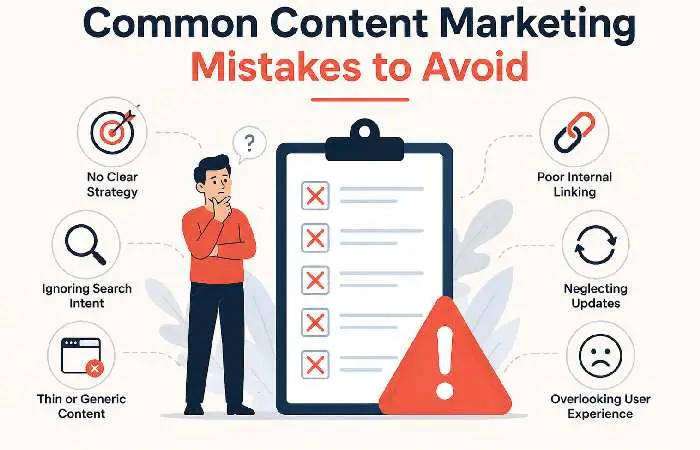
Several companies adopt It strategies and fail to achieve success because of preventable errors. These errors may include creating content without proper planning, not using search engine optimization tactics, reaching out to the wrong target market, and producing content of poor or inconsistent quality. One of the most prevalent errors that can be made in It is forgetting about content updating and linking.
Publishing Without a Strategy
Random content rarely generates consistent results.
Solution: Develop a documented content strategy.
Ignoring SEO
Creating content without keyword optimization limits visibility.
Solution: Conduct keyword research before publishing.
Focusing Only on Sales
Overly promotional content discourages engagement.
Solution: Prioritize education and value.
Inconsistent Publishing
Irregular posting reduces momentum.
Solution: Follow a content calendar.
Neglecting Content Updates
Outdated content loses rankings.
Solution: Refresh content regularly.
Not Tracking Results
Without analytics, improvement becomes difficult.
Solution: Monitor performance metrics monthly.
Conclusion
It is one of the finest digital marketing methods for creating brand awareness, bringing in traffic, and facilitating the growth of a business in the future. With the help of developing quality content that resonates with its target market, companies establish themselves and become authorities in their industry. The approach of marketing must consider three important factors, namely SEO, content publishing, and analytics.
Marketers need to be aware of different types of content and how not to make certain mistakes. With the search engine algorithms constantly encouraging helpful content creation, It becomes even more crucial to achieve success in marketing efforts.
FAQ
Is content marketing equivalent to SEO?
No, since SEO helps achieve better ranking on the search engine, whereas It helps ensure that there is valuable content generated, which attracts traffic.
How long will I wait before seeing the fruits of content marketing?
One will usually begin to see the effects of marketing with SEO after 3-6 months, but one usually begins seeing outstanding results after 1 year or so.
Who requires content marketing?
Almost everyone, whether they run an eCommerce business, a software service business, a physical business locally, a professional practice, a business in the health care field, or B2B, and so forth.
Can I afford content marketing?
Affordable is the right answer here; valuable content keeps generating traffic and leads year after year.
Why should I have content marketing?
Mainly due to the fact that it helps build trust and attracts valuable organic traffic.