

Fahmeena creates clear and practical content across digital marketing, technology, business growth and emerging digital trends.

Sameena reviews digital content for clarity, factual presentation, consistency and overall reader usefulness.
Introduction
Content Strategy and planning are vital steps in digital marketing strategies and SEO in the year 2026. Through this process, companies are able to establish the nature of content that they should be producing, the time, and whether the content matches the intent of their clients. Any content not produced with this strategic approach would hardly be able to achieve top positions in the search results and gain consistent visits, no matter how high-quality it may be. Effective planning will help enhance keyword targeting and increase customer engagement as well as brand visibility. In the following chapter, we are going to talk about the creation of an effective content strategy with the help of SEO.
A successful strategy starts with understanding how professional content marketing services help businesses attract, engage, and convert their target audience.
A clear understanding of what content marketing is makes it easier to build a strategy that aligns content creation with business and audience needs.
📈 This article is part of our
Content Marketing
How to Build a Content Marketing Strategy?
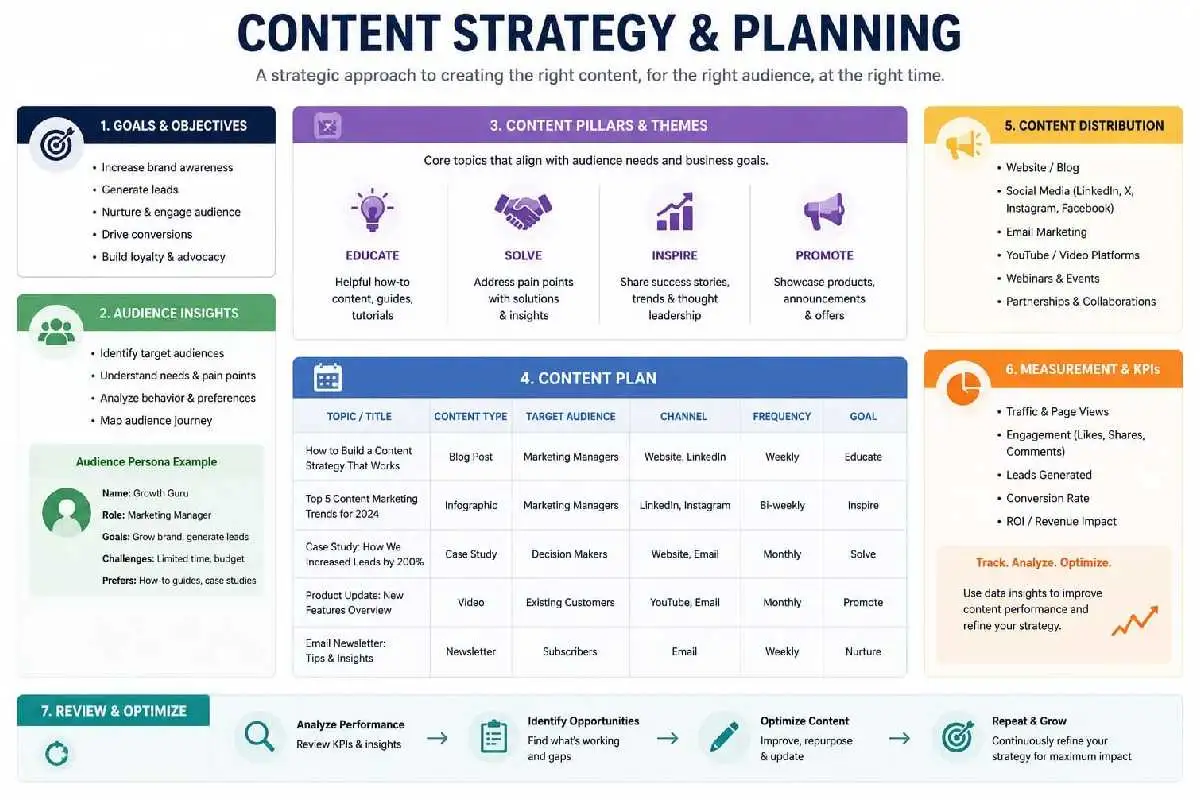
The key thing for the creation of an efficient content marketing strategy is the establishment of the goals of your company. The goals can be related either to driving more traffic, generating leads, creating awareness about your brand, or something else. Secondly, it is necessary to determine the target audience through research.
Thirdly, it is essential to conduct keyword research in order to define topics with high performance potential. After you finish working with keyword mapping, start developing the content based on the buying funnel phases. Plan your content creation using content calendars. Finally, track your metrics.
Understanding the benefits of content marketing can help businesses set realistic goals for organic traffic, brand awareness, lead generation, and long-term customer engagement.
Even the best plans require a reliable content creation process to consistently publish valuable and engaging content.
Define Clear Goals
The very first thing that needs to be done for building a content marketing plan is to define the objectives of your business. They can be related to the increase in your website traffic or lead generation, etc.
Before building a strategic plan, it’s important to learn the basics of content marketing and how content supports business growth.
Know Your Target Audience
It is something that you will have to know by conducting some research about your target audience. You must develop your buyer persona to make the process of developing content much easier for you.
Do Keyword and Topic Research
Keyword and topic research play an important role in creating relevant content for the customers. Use SEO tools to figure out some effective keywords and cluster them according to their search intent.
Make a Content Distribution Strategy
After the research has been carried out, it will then be time to know how and where the content will be disseminated.
Effective strategies are built around accurate buyer personas for content marketing that guide audience targeting.
Content Calendar Creation Guide
Content calendars are basically an organized way of handling all aspects of content marketing efforts, both in terms of organization and planning. It will ensure better workflow efficiency as well as the relevant nature of the content marketing activities undertaken. For preparing a content calendar, one needs to list down the topics chosen for the content, keywords to be utilized, and the rate of content publishing per week/month.
Key Elements:
- Publishing frequency
- Keyword mapping
- Seasonal trends
- Funnel stage alignment
Example Content Calendar Structure (2026):
| Week | Topic | Keyword Cluster | Format | Goal |
| Week 1 | SEO Strategy Guide | Content strategy | Blog | Traffic |
| Week 2 | Content Calendar Setup | Planning | Tutorial | Engagement |
| Week 3 | Audience Research | Research | Blog | Awareness |
| Week 4 | Content Gaps Analysis | SEO optimization | Case study | Leads |
Strong planning should also incorporate content conversion optimization to improve marketing ROI.
Content Planning for Small Businesses
Content strategy plays an essential role for small businesses as it allows them to compete with bigger corporations without having many resources. Such a content strategy will help a business to achieve constant exposure and better target its audience at a reasonable expense of time and money spent on the marketing process.
- Concentrate on Highly Intent-Based Keywords
Choosing keywords for which there is evident demand to perform some actions will make small businesses’ work much more efficient, as it does not make sense to use any other type of traffic.
- Establish a Content Calendar
Having a simple schedule that involves at least 2-3 blog articles per week will provide enough opportunities to generate good results.
- Repurpose the Same Content through Different Mediums
A blog post may also be repurposed through the use of social media platforms, a video clip, or even through an email newsletter.
- Leverage Local SEO with Niche Subjects
Leveraging local SEO with niche subjects will allow the business to get to the top more quickly.
- Track All Results Using Available Tools
Google Analytics and Search Console can be extremely helpful in doing so.
How to Identify Content Gaps
Content gaps identification is a process through which topics that your competitors are ranking for and that your site is not adequately addressing can be identified. It helps you to take advantage of this SEO opportunity by adding important content to fill those gaps in order to become a topic authority and generate more traffic.
An effective strategy should include SEO content marketing to improve search visibility and attract qualified organic traffic.
Key Methods to Identify Content Gaps
Competitor Content Analysis: Analyze your content against high-performing competitor content in order to spot content gaps within particular topics.
SEO Keyword Gap Tools: Use SEO keyword gap tools such as Semrush and Ahrefs in order to find gaps.
SERP Analysis: Know the type of content that performs well from Google SERP analysis.
Google Search Console: Examine areas where your website is receiving impressions without clicks or rankings.
Search Queries of Users: Locate user queries by analyzing “People Also Ask” sections and forums.
Content Gap Analysis Table (2026 Example)
| Topic Area | Competitor Coverage | Your Website Coverage | Gap Level | Opportunity Action |
| AI Content Strategy | High | Low | High Gap | Create a detailed AI strategy guide |
| Content Calendar Templates | Medium | Low | Medium Gap | Build downloadable templates |
| SEO Content Planning | High | Medium | Medium Gap | Expand with the updated 2026 framework |
| Small Business Content Strategy | Low | Low | Very High Gap | Create niche-focused pillar page |
| Audience Research Methods | High | Low | High Gap | Add a step-by-step research guide |
Businesses are increasingly integrating AI content marketing solutions into their strategic planning processes.
Audience Research for Content Marketing
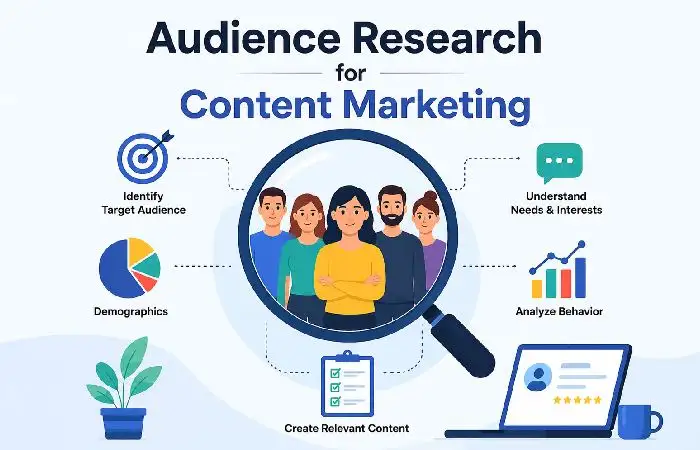
The practice of understanding the target audience for content marketing involves understanding the people you want to reach through the content marketing strategy. The goal of such research is to help marketers understand their target users, keywords used by them, and content that persuades them in one way or another.
Key Steps for Audience Research
Demographic Data: Find out the age, geographic location, occupation, and income level of your audience.
User Search Behavior: Discover how users interact with search engines for a bit of information.
Behavior Analysis: Find out about user behavior using analysis software.
Social Media Trends: Study user behaviors and interactions between users within your target audience.
First-Hand Information about Users: Interview the target audience and take surveys from the target audience.
A long-term strategy should focus on authority building through content marketing to strengthen credibility and audience trust.
Audience Research Methods Comparison Table (2026)
| Method | Purpose | Tools Used | Effectiveness | Best Use Case |
| Google Analytics | Track user behavior | GA4 | High | Website performance insights |
| Keyword Research | Understand search intent | Semrush, Ahrefs | Very High | SEO content planning |
| Social Listening | Monitor trends & opinions | Brandwatch, Hootsuite | Medium | Content ideas & engagement |
| Surveys & Polls | Collect direct feedback | Google Forms, Typeform | High | Customer pain points |
| Competitor Analysis | Identify audience gaps | Semrush, SimilarWeb | Very High | Content gap discovery |
Conclusion
If there are to be improvements on SEO, consumer engagement, and brand awareness, it is important to have a well-thought-out strategy and approach towards content creation in the year 2026. Being knowledgeable about your target consumers, understanding what the gap is between yourself and quality content, and having a good plan for content production will allow you to come up with content that will assist in growing your business. Through analyzing your competition, it becomes quite clear that there are many reasons behind their success; among them is having a strategy and content.
Many brands improve results by incorporating industry-specific content marketing that addresses niche audience needs and challenges.
Fahmeena Begum is a Digital Marketing & Technology Writer at Web Digi Marketing with 3+ years of writing experience. Her work covers digital marketing, SEO, content marketing, business growth, digital tools, artificial intelligence, software and emerging technologies.
View Author Profile →
Sameena Begum is a health, technology and digital content reviewer with 8 years of experience. Her review work focuses on editorial clarity, factual presentation, consistency and reader usefulness across technology and digital subjects.
View Reviewer Profile →