
Fahmeena creates clear and practical content across digital marketing, technology, business growth and emerging digital trends.

Sameena reviews digital content for clarity, factual presentation, consistency and overall reader usefulness.
Introduction
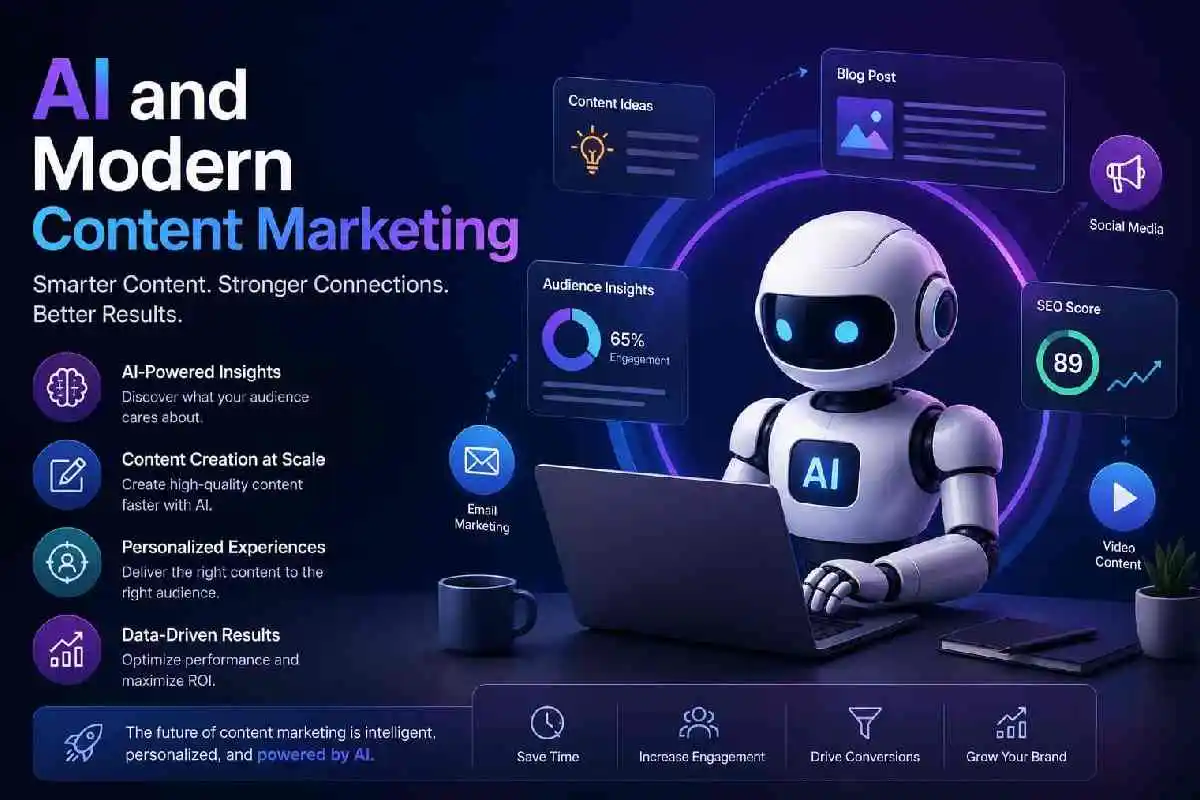
AI & Modern Content Marketing: In the case of AI technologies, there has been huge innovation in the ways brands generate, distribute, and publish their content on the internet. Using the fusion of new-age AI technology and content marketing would be greatly advantageous to businesses when creating more personalized and fast content for their customers while enhancing SEO in 2026. However, professional marketers do not rely solely on artificial intelligence in their work; they complement each other.
Today, modern content marketing is no longer confined to the creation of blogs. It encompasses AI-powered SEO optimization, content automation, targeting of audiences, prediction, analytics, and content distribution aided by artificial intelligence. Businesses adopting these changes benefit from increased visibility on Google Search, AI Overviews, ChatGPT, and Perplexity.
According to recent research, today more than 75% of marketing specialists are employing AI tools in their work process, while the usage of AI SEO helps businesses produce content in much shorter periods of time.
To maximize reach, many teams combine AI-generated content with effective content promotion and distribution strategies across multiple channels.
📈 This article is part of our
Content Marketing
What Is AI in Modern Content Marketing?
Artificial intelligence in modern content marketing is the application of AI and automation solutions in the creation and optimization of content. It allows companies to enhance their SEO efforts and understand audience behavior.
If you are new to the subject, start by understanding what content marketing is and how it helps businesses attract and engage their target audiences.
The effectiveness of AI-generated content should be measured through content conversion optimization techniques that focus on business outcomes.
- Keyword research
- Content planning
- Blog writing
- SEO optimization
- Content personalization
- Email marketing automation
- Social media scheduling
- Analytics and reporting
Key Areas Where AI Helps
| Content Marketing Task | How AI Helps |
| Keyword Research | Finds trending keywords instantly |
| Content Writing | Generates drafts and outlines |
| SEO Optimization | Suggests NLP keywords and structure |
| Email Marketing | Personalizes campaigns |
| Social Media | Creates captions and schedules posts |
| Analytics | Predicts user behavior and trends |
AI tools become more valuable when guided by detailed buyer personas for content marketing that improve personalization and relevance.
AI in Content Marketing: Pros and Cons
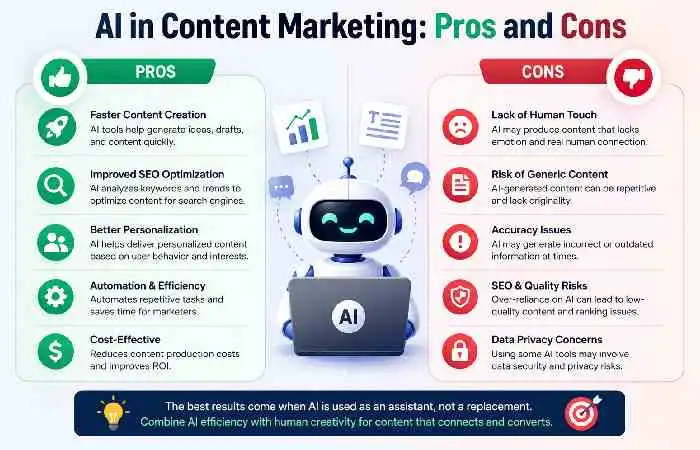
The practice of artificial intelligence in content marketing ensures that the organization will produce its content faster, optimize it for SEO purposes, and automate marketing processes. The organization will be able to track the behaviors of the workers and create a customized marketing campaign. However, being contingent solely on artificial intelligence will lead to the creation of generic gratified and errors in information.
Pros of AI Content Marketing
Faster Content Production
AI tools can make outlines, drafts, and notes within seconds. It helps businesses scale content production fast.
Improved SEO Optimization
Current AI SEO tools examine top-ranking pages and recommend keyword practice, internal linking, and readability improvements.
Better Personalization
AI can modify content based on operator behavior, location, benefits, and search intent.
Cost Efficiency
Small businesses can reduce working costs by automating boring marketing tasks.
Cons of AI Content Marketing
Lack of Human Experience
AI cannot fully repeat real-world expertise, emotions, storytelling, or individual insights.
Risk of Generic Content
Clean AI-generated articles may become boring and lack innovation.
SEO Risks
Thin AI gratified without E-E-A-T signs may fight vigorously in Google Search.
Fact Accuracy Issues
AI tools occasionally produce outdated or improper information that needs human editing.
Best AI Tools for Content Marketing
Tools that are used to facilitate AI in content marketing include automation of writing, optimization for search engines, social networking activities, and customer communications. In 2026, AI platforms will allow marketers to be more productive. Choosing an appropriate AI platform for marketing operations is based on your aims and budget.
Top AI Content Marketing Tools Comparison (2026)
| AI Tool | Best For | Main Features | Ideal Users |
| OpenAI ChatGPT | Content writing & ideas | Blog drafts, outlines, and keyword ideas | Bloggers & marketers |
| Jasper | Brand-focused content | Brand voice templates, AI copywriting | Agencies & businesses |
| Surfer SEO | SEO optimization | NLP keywords, content scoring | SEO professionals |
| SEMrush | Keyword research | SEO audits, competitor analysis | Businesses & SEO teams |
| Canva Canva AI | Visual content creation | AI image generation, social graphics | Social media marketers |
| HubSpot AI | Marketing automation | Email workflows, CRM integration | Enterprises & startups |
Human vs AI Content Writing
Irrespective of whether content is written by humans or produced using an AI, it is essential for any modern digital marketing strategy. Even though the artificial intelligence does a fantastic job of working quickly, generating new ideas, and even optimizing the final content, there will always be the necessity of involving a human writer to bring creativity, emotions, stories, and expertise into the text. Therefore, the optimal solution would be utilizing AI while having some human editors at hand in 2026.
Understanding the content marketing fundamentals is essential before implementing AI-driven content workflows.
AI Content Benefits
AI can make content workflows more efficient, while the benefits of content marketing extend to brand visibility, organic traffic, audience engagement, and long-term customer relationships.
- Speed of writing
- Huge scalability
- SEO optimization
- Repurposing content
Human Content Strengths
- Human experience
- Creating stories
- Expert analysis
- Authority of brands.
Which One Is Better for SEO Purposes?
The studies and SEO community confirm that content made up by humans on the basis of AI drafts is superior to 100% AI-produced content concerning SEO optimization.
Hybrid Process Recommendations
-
- Spend some time researching keywords and creating outlines
- Create your initial draft with AI writing tools
- Mix it up with personal insight
- Edit manually for SEO optimization and readability
- Check facts before publishing
Businesses using artificial intelligence can achieve better results when AI tools are integrated into a complete content marketing services strategy that aligns content with business objectives.
How AI Is Changing SEO Content Strategy?
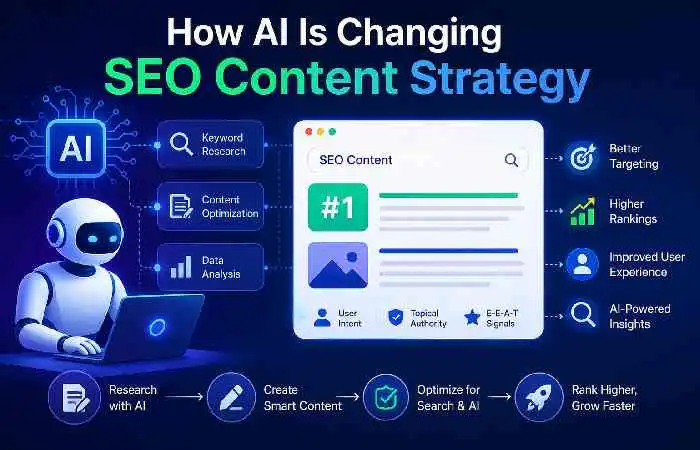
The answer is simple; it helps to create data-driven and search intent content faster than ever before. With the help of AI technology, content optimization becomes better through keyword analysis, competitor pages, user behavior, and rankings. For instance, SEO in 2026 will be all about creating helpful content, expertise, E-E-A-T, and user experience, and not just keywords.
Many marketers use AI to support SEO content marketing techniques such as keyword research, optimization, and content planning.
Keyword stuffing is already a thing of the past and will soon become ineffective. Rather than keyword-stuffing your website, search engines care about:
- helpful content,
- expertise,
- topical authority,
- satisfaction,
- proper structuring,
- trust.
GEO: Generative Engine Optimization
SEO has advanced further into including GEO, which stands for Generative Engine Optimization.
Modern SEO Best Practices
| Old SEO Strategy | Modern AI SEO Strategy |
| Keyword stuffing | Intent-focused writing |
| Thin articles | Comprehensive topic clusters |
| Mass publishing | High-quality expert content |
| Backlink-only focus | E-E-A-T + authority signals |
| Generic blogs | Original insights and data |
Consistently producing valuable AI-assisted content can strengthen content authority building efforts and brand credibility.
AI Content Optimization Tips
Content optimization using AI enables marketers to enhance readability, performance in SEO ranking, engagement levels of users, and even the visibility of the content within the searches made. As such, in 2026, simply creating AI content will not be enough; businesses have to optimize their AI content using the skills of humans and E-E-A-T principles.
Organizations across different sectors are adopting AI to enhance industry-specific content marketing campaigns and audience targeting.
Use Search Intent-Based Keywords
Keywords essential to be chosen based on what the operators are really targeting, and that includes keywords with informational, profitable, and transactional purposes.
Add Human Experience and Expertise
| Human Element | Why It Matters for SEO |
| Personal Case Studies | Builds trust and real-world credibility |
| Original Screenshots | Improves authenticity and user engagement |
| Expert Opinions | Strengthens E-E-A-T signals |
| Real Examples | Makes content more relatable and useful |
| Industry Insights | Adds unique value beyond AI-generated text |
| Fact-Checking | Ensures content accuracy and reliability |
Improve Readability and Structure
Apply short sections, bullet points, tables, and titles to increase legibility and understanding of content. Good content structuring is known to boost reader engagement and decrease bounce rate.
Optimize Your Internal Links
Make use of internal links in your blogs and services to strengthen the topical authority of your site and aid site navigation. Internal linking will assist in comprehending the structure of your website by the search engines.
Keep Updating Content
Inform AI-written content regularly, finish new stats, data, and SEO trends to recall higher ranks on modest search engines and AI-powered search results.
Successful implementation requires a clear content marketing strategy framework that defines goals and performance metrics.
Conclusion
AI & Modern Content Marketing: The Future of Digital Marketing, SEO & Online Brand Growth in 2026. Modern companies make use of various types of AI technologies when it comes to the acceleration of content creation and optimization process, keyword optimization, personalization, automation of routine marketing tasks, etc. Nevertheless, a good content strategy still relies on creative thinking and the expertise of human beings.
The most effective approach is a blend of efficiency and human editing. Those brands that concentrate on E-E-A-T, useful and helpful content, and the intention behind searches are much more likely to get high rankings within Google Search, as well as AI-powered search features.
Fahmeena Begum is a Digital Marketing & Technology Writer at Web Digi Marketing with 3+ years of writing experience. Her work covers digital marketing, SEO, content marketing, business growth, digital tools, artificial intelligence, software and emerging technologies.
View Author Profile →
Sameena Begum is a health, technology and digital content reviewer with 8 years of experience. Her review work focuses on editorial clarity, factual presentation, consistency and reader usefulness across technology and digital subjects.
View Reviewer Profile →