

Fahmeena creates clear and practical content across digital marketing, technology, business growth and emerging digital trends.

Sameena reviews digital content for clarity, factual presentation, consistency and overall reader usefulness.
The increase in internet consumption refers to the rapid growth in the use of online services, digital content, and connected devices worldwide. Over the past decade, internet usage has expanded significantly due to technological advancements, affordable smartphones, and faster connectivity. Countries like India have experienced especially strong growth because of low-cost data and large populations coming online.
📈 This article is part of our
SEO Tools
What is Internet Consumption?
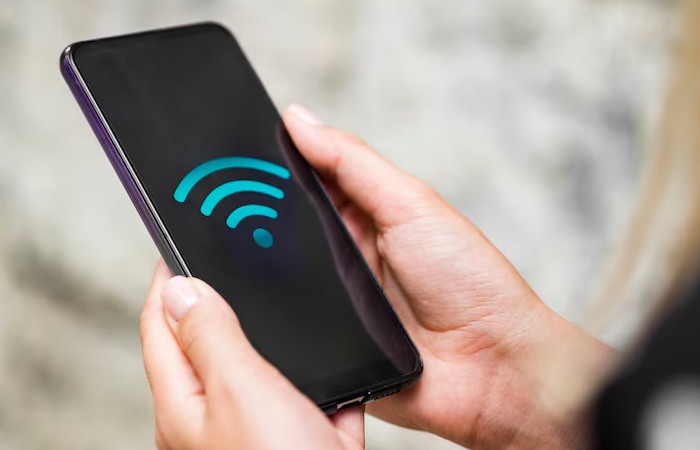
Data usage is affected by downloading movies, photos, and music, uploading videos and pictures, or browsing the web. Limited usage plans are generally cheaper than unlimited ones, but if you exceed the required data limit, you may be charged an extra fee.
What are the Types of Increase in Internet Consumption?
Some online auctions use much more data than other online activities. Some of the more data-intensive things you can do are:
- Streaming audio or video, either on the web or through an app
- Download large files like music or videos
- Loading websites with lots of images
- Video call
- Run speed tests.
| Type of Internet Consumption | Description | Examples / Platforms | Key Drivers |
| Social Media Usage | Growth in time spent on social networking, messaging, and content sharing. | Facebook, Instagram, WhatsApp | Digital communication, online communities |
| Video Streaming | Increased demand for video content such as movies, web series, and tutorials. | YouTube, Netflix | Entertainment, education, 4G and 5G growth |
| Online Gaming | Higher internet use for multiplayer and cloud-based gaming. | PUBG Mobile, Call of Duty: Mobile | Mobile apps, youth engagement |
| E-commerce and Online Shopping | Growth in online buying, selling, and digital marketplaces. | Amazon, Flipkart | Convenience, digital payments |
| Digital Payments and Banking | Increase in online financial transactions and mobile wallets. | Google Pay, Paytm | Financial inclusion, security |
| Remote Work and Collaboration | Online tools for communication, teamwork, and project management. | Zoom, Microsoft Teams | Work-from-home trends |
| Online Education and Learning | Increased use of e-learning platforms and virtual classrooms. | Coursera, Byju’s | Digital education, pandemic impact |
| Cloud and Data Services | Growth in cloud storage, software services, and online data access. | Google Cloud, Microsoft Azure | Business digitalization |
| Internet of Things (IoT) | Increase in connected devices such as smart homes and wearables. | Smart devices, connected vehicles | Automation, smart technology |
| News and Information Consumption | More people accessing digital news, blogs, and online media. | News apps, websites, podcasts | Instant updates, mobile access |
Key Reasons for the Increase in Internet Consumption
The rapid growth in internet consumption is driven by multiple technological, economic, and social factors. Below are the main reasons behind this global trend, especially in developing countries like India.
A strong technical SEO foundation also helps search engines crawl, understand, and index your website, which can improve its ability to generate organic traffic.
1️. Affordable Smartphones and Internet Plans
The availability of low-cost smartphones has made it easier for people from different income groups to access the internet. Telecom companies such as Reliance Jio and Bharti Airtel have introduced affordable data plans, encouraging millions of new users to come online.
2️. Growth of Social Media Platforms
Social media apps have become a daily part of life, increasing the time people spend online. Platforms like Facebook, Instagram, and TikTok attract users with engaging content such as reels, short videos, and live streaming.
3. Expansion of Video Streaming and Entertainment
The demand for digital entertainment has grown significantly. Services like Netflix and YouTube provide movies, series, and educational content, leading to higher data usage.
4️. Online Education and Remote Work
The COVID-19 pandemic accelerated digital adoption worldwide. Tools such as Zoom and Google Meet became essential for virtual learning and working from home.
5️. E-commerce and Digital Payments
Online shopping and digital transactions have boosted internet use. Companies like Amazon and Flipkart, along with digital payment platforms, encourage users to stay connected.
6️. Mobile Gaming and Apps
The rise of mobile gaming has significantly increased data consumption. Popular games such as PUBG Mobile and other app-based entertainment require constant internet connectivity.
7. Government Digital Initiatives
Many governments promote digital services such as e-governance, online health, and digital identity programs. Initiatives like Digital India have increased internet adoption in rural and urban areas.
8. Faster Connectivity (4G and 5G)
The rollout of high-speed networks has improved user experience. Faster speeds encourage activities such as HD streaming, cloud computing, and real-time communication.
What are Cause of the Increase in Internet Consumption?
Several factors contribute to high usage, but a large part depends on frequent activities. Your usage numbers are likely to be increased if you have devices like computers, tablets, smartphones, or surveillance cameras running all the time. You can take numerous steps to limit their use, including:
Make sure your connection is password protect. You can significantly reduce your data volumes when fewer people access your network. Additionally, it violates our AUP for Subscribers to resell or share our Services intentionally. You should be aware that you are responsible for any illegal activity on your network, regardless of who obligates the violation. So make sure you control who has the approval to use your WiFi. Hence you have a router provided by Ritter Communications, your technician will set a password for your WiFi network during installation. If you are not using Ritter devices, check the manufacturer’s website for instructions on setting a password.
mplementing a consistent SEO strategy can help improve search visibility, attract qualified visitors, and build sustainable website traffic over time.
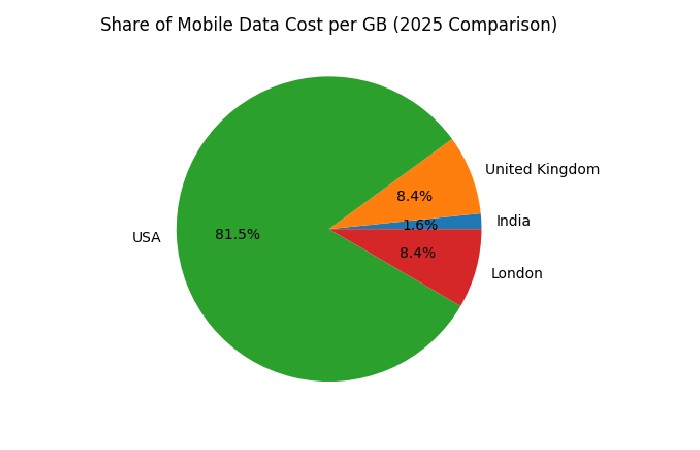
Share of Mobile Data Cost per GB 2025 Comparison
The Share of Mobile Data Cost per GB (2025 Comparison) compares mobile data prices per gigabyte across different countries. It shows how each nation’s data costs impact the total judgment set and shows affordability differences. For example, India has a very small share due to low per-GB prices, but the United States holds a much higher share because its mobile data costs per GB are notably higher.
| Country | Avg. Cost per 1 GB (USD) | Notes / Context |
| India | $0.09 | One of the cheapest mobile data prices globally in 2025. |
| United Kingdom | $0.62 | Relatively priced data in a developed market. |
| United States | $6.00 | Between the higher mobile data prices globally. |
| China | $0.37 | Lower than many developed countries. |
| World Average | $2.59 | Global usual cost per GB in the 2025 data set. |
Mobile Devices Speed up Digital Connections
Although global access to the Internet is constantly increasing, the connection quality in countries with developed infrastructure is higher. As of 2021, Monaco has the wildest average fixed broadband internet speed universal. Mobile internet has become more unescapable as smartphones become more widely available and affordable. As Internet users slowly switch to mobile devices to surf the Internet, mobile Internet accounts for almost 57 percent of all web traffic universally.
Impact of Increased Internet Consumption
The rapid growth in internet usage has transformed modern society in many ways. It has created new opportunities in business, education, and communication while also introducing challenges related to privacy, health, and digital security. Countries such as India have seen major social and economic changes due to increased internet consumption.
For businesses that depend on customers in specific geographic areas, local SEO can help increase visibility in location-based searches and drive more relevant traffic to the website.
Positive Impacts
1️. Improved Communication and Connectivity
The internet enables instant communication across the world. Platforms like WhatsApp and Facebook allow people to stay connected with friends, family, and businesses in real time.
2️. Growth of the Digital Economy
Online businesses and digital platforms have created new job opportunities and industries. Companies such as Amazon and Flipkart support entrepreneurship and online retail growth.
3️. Access to Education and Information
Students and professionals can learn from online courses, tutorials, and webinars. Educational platforms and video content on YouTube have made knowledge accessible worldwide.
4️. Financial Inclusion and Digital Payments
The internet has improved banking access, especially in rural areas. Digital payment services and online banking have made transactions faster and safer.
5️. Remote Work and Flexibility
Many companies now support work-from-home options using tools such as Zoom and Microsoft Teams, improving work-life balance.
6️. Healthcare and Telemedicine
Online health consultations, digital records, and telemedicine services have made healthcare more accessible.
Negative Impacts
1️. Cybersecurity and Privacy Risks
Increased internet use has led to higher risks of cybercrime, hacking, identity theft, and data breaches.
2️. Screen Addiction and Mental Health Issues
Excessive use of social media and digital devices may cause stress, anxiety, and reduced productivity.
3. Spread of Misinformation and Fake News
False information spreads quickly on social media, influencing public opinion and causing confusion.
4️. Digital Divide
Some regions still lack internet access, creating inequality between urban and rural populations.
5️. Reduced Physical Activity
Spending more time online can reduce physical exercise and lead to health problems.
6️. Environmental Impact
Increased internet consumption leads to higher energy use in data centers and electronic waste.
Mobile Data Increase in Internet Consumption by Country
Mobile data management has increased globally due to streaming, social media, and remote work. India, China, and the Gulf countries lead in data spending per smartphone, while North America and Western Europe show high overall net usage. States like Sub-Saharan Africa still have decreased data consumption due to reduced transportation.
| Rank/Region | Country/Region | Mobile Data Usage |
| 1 | India, Nepal & Bhutan | ~36 GB per month (highest globally) |
| 2 | Gulf Cooperation Council (e.g., Saudi Arabia, etc.) | ~30–35 GB per month |
| 3 | Western Europe | ~25 GB per month |
| 4 | North America | ~25 GB per month |
| 5 | Central & Eastern Europe | ~21–22 GB per month |
| 6 | South East Asia & Oceania | ~21 GB per month |
| 7 | North East Asia (e.g., China, Japan) | ~20–21 GB per month |
| 8 | Latin America | ~15 GB per month |
| 9 | Sub-Saharan Africa | ~5–7 GB per month |
Internet Usage and Most Popular Online Activities
As the Internet has developed into an indispensable tool for information, communication, and entertainment, the average daily amount of time spent per capita is increasing yearly. In 2021, users spent a projected 192 minutes per day online, mostly on their smartphones. Some popular mobile Internet activities include instant messaging services, video streaming platforms, and social media. On average, Internet users spend more than 140 minutes daily on social networks, and Facebook remains the leading social network worldwide.
Internet and Social Media Users in the World 2025
Here’s the latest available global data for Internet and social media users in the world in 2025 based on the examination and digital people reports, which display how many people were online and alive on social display platforms during that year:
| Metric | Number (2025) | % of World Population |
| Internet Users | ~5.56 billion (Statista) | ~67.9 % of population |
| Social Media Users | ~5.24 billion (Statista) | ~63.9 % of population |
| Internet Users | ~6.04 billion (DataReportal, October 2025) | ~73.2 % of population |
| Social Media Users | ~5.66 billion (DataReportal, October 2025) | ~68.7 % of population |
The Global Development of E-Commerce and Digital Awareness
The Internet has recently changed how products are accepted and sold worldwide. As shoppers progressively shop online, global e-commerce retail sales topped $4.2 billion in 2020. In addition, an increasing number of online transactions conducts via mobile devices, making mobile commerce an increasingly profitable industry. But as digital literacy increases, so do concerns about online privacy, fraud, and also hacking. This text contains general information. Statista assumes no responsibility for the completeness and accuracy of the information provided. In addition, due to different update cycles, the statistics may show more recent data than in the text.
Effective keyword research helps identify the search terms your target audience uses, allowing you to create content that can attract more relevant organic traffic.
Global Internet Use Continues to Rise, with an Increase in Internet Consumption
Global Internet use is expected to grow each day as connectivity improves, data costs decline, and devices get larger. More people are coming online, and existing users are spending more time on running, social media, cloud apps, and digital services. Reports from organizations like the International Telecommunication Union consistently show year-over-year increases in both operators and data traffic.
| Factor | Current Trend | Effect on Internet Consumption |
| Number of Internet Users | Increasing yearly | Expands total global traffic |
| Mobile Internet Access | Rapid growth | More daily, always-on usage |
| Video & Streaming | Dominant traffic type | High data consumption per user |
| Social Media Usage | Rising active users | Continuous content loading & sharing |
| Remote Work & Learning | Now mainstream | More video calls & cloud access |
| 4G / 5G Expansion | Wider coverage | Faster speeds → higher usage |
| Smart Devices & IoT | Growing assumption | Constant background knowledge connectivity |
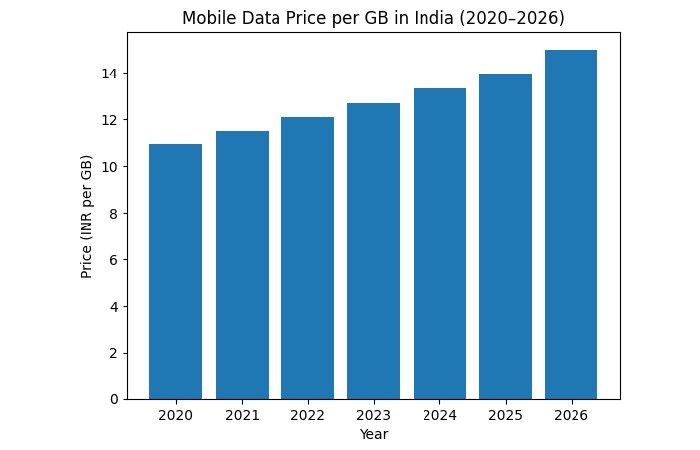
Mobile Data Price Per GB in India 2020-2026
Mobile data prices in India from 2020 to 2026 show a steady upward trend, rising from ₹11 per GB in 2020 to ₹14–₹15 per GB by 2026 (estimated). Although the increase, India still ranks among the lowest-cost mobile data markets globally, and is associated with strong growth in internet consumption.
| Year | Approx. Data Price (₹ per GB) | Notes / Source |
| 2020 | ~₹10.95 per GB | Reported average price in 2020. |
| 2021 | ~₹11.50 per GB | Slight increase year-on-year based on data projection. |
| 2022 | ~₹12.07 per GB | Continued affordable pricing with rising usage. |
| 2023 | ~₹12.68 per GB | Gradual pricing with telecom growth. |
| 2024 | ~₹13.31 per GB | Mobile data remains extremely cheap. |
| 2025 | ~₹13.98 per GB (projected) | Projected average price. |
| 2026 | May rise slightly with tariff changes | Industry reports suggest potential telecom price increases in 2026, which could affect recharge plan prices. |
Mobile Data Cost per GB 2025 Comparison Table
| Country / City | Avg. Cost per 1 GB Mobile Data (USD) | Typical Monthly Bare‑Smallest Broadband (USD) | Notes on Price Trends |
| India | ~$0.09 — ~$0.16 per GB (very low) | ~$4.76 for fixed broadband (lowest globally) | India has very low mobile data prices, driving high consumption and rapid digital adoption. |
| United Kingdom | ~$0.62 per GB | ~$22.51 for fixed broadband | UK mobile data and broadband are moderately priced; affordability increases by salary share. |
| USA | ~$6.00 per GB (among higher rates globally) | ~$25.00 for fixed broadband | The US is one of the more expensive places for mobile data, paying higher overall internet costs. |
| London (City) | Same as UK avg (~$0.62 per GB) | Same as UK avg (~$22.51) | London’s pricing aligns with UK national rates; living costs are higher, so actual affordability is lower than the rest of the UK. |
Tracking Connectivity Trends: An Increase in Internet Consumption
| Trend | What It Is | Impact on Internet Consumption |
| Mobile Broadband Expansion (4G/5G) | Faster, wider handling of cellular internet | Increases data usage for video issuing, apps, and social platforms |
| Affordable Data Plans | Lower cost per GB and bundled packages | Encourages heavier daily usage and digital activities |
| Smartphone Access Growth | More people are owning smartphones | Larger user base creating more overall traffic |
| Fiber & Fixed Broadband Growth | High-speed internet at home/work | Increases streaming, remote work, and online education |
| Wi-Fi Accessibility in Public Seats | Free/cheap hotspots in cafes, malls, and transportation | Helps users consume the internet on the go |
| Cloud Services Adoption | Use of cloud storage and apps | Constant sync and uploads increase background data usage |
| IoT & Connected Devices | Smart devices are constantly communicating | Adds steady background data needs |
| Remote Work & E-Learning | Work/school tasks online | More video calls and large downloads/uploads |
| Social Media Platform Growth | More contents and active users | Slowly increases video/image data consumption |
| Digital Services & OTT Platforms | Running, gaming, and digital payments | Big driver of peak data usage hours |
Level of Development and Connectivity Closely Linked to Internet Consumption
| Development Level | Connectivity Infrastructure | Average Internet Consumption | Key Drivers | Common Challenges |
| Very Developed Countries | Advanced fiber broadband, widespread 4G/5G, high Wi-Fi access | Very High | Coursing (4K), cloud services, remote work, smart homes, online gaming | Network overcrowding, cybersecurity risks, and high data demand |
| Upper-Middle Income Countries | Strong mobile networks, growing fiber in cities | High | Affordable smartphones, social media, video courses, e-commerce | Urban–rural connectivity gap |
| Lower-Middle Income Countries | Mobile-first internet, growing 4G reporting | Moderate to High (fast growth) | Cheap mobile data, app usage, short-video platforms, and digital expenses | Limited fixed wideband, speed variability |
| Developing / Low-Income Countries | Limited broadband, patchy mobile coverage | Low to Moderate | Basic browsing, messaging apps, and mobile services | Infrastructure cost, device affordability, unstable networks |
| Least Connected Regions | Sparse network organization | Low | Basic communication and government/education access | Analysis gaps, high relative data cost, and power dependability |
Conclusion
Especially for people with social anxiety and also other similar disorders. Online communication can be a powerful tool for developing communication skills and becoming more comfortable with social interactions. Therefore, we have to say that the global effect of the Internet on our social life has also been positive.
Fahmeena Begum is a Digital Marketing & Technology Writer at Web Digi Marketing with 3+ years of writing experience. Her work covers digital marketing, SEO, content marketing, business growth, digital tools, artificial intelligence, software and emerging technologies.
View Author Profile →
Sameena Begum is a health, technology and digital content reviewer with 8 years of experience. Her review work focuses on editorial clarity, factual presentation, consistency and reader usefulness across technology and digital subjects.
View Reviewer Profile →