

Financial projections are estimates of a company’s future financial performance based on historical data, market analysis, and assumptions about growth. They are forward-looking statements that outline expected revenue, expenses, profits, cash flows, and other financial metrics over a specific period, usually 3–5 years.
What is Financial Projection in a Marketing Plan?
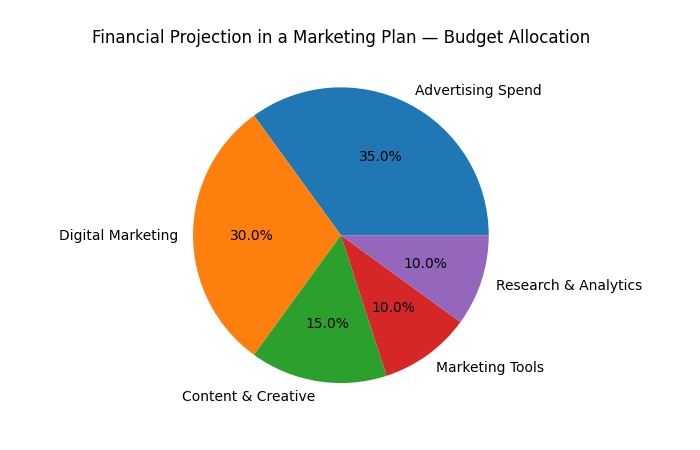
Financial projections in a marketing plan are guesses of the revenue, costs, and profits likely to result from marketing actions over a specific period. It explains marketing strategies such as movements, marketing spend, and customer acquisition into measurable financial results to show expected return on investment (ROI) and budget influence.
| Aspect | Description | Purpose / Example |
| Definition | A financial projection in a marketing plan estimates future financial outcomes resulting from marketing activities, including revenue, costs, and profitability. | Helps forecast how marketing campaigns affect overall business finances. |
| Revenue Forecast | Projected income generated from marketing-driven sales or leads. | Example: Launching a social media campaign is expected to generate $50,000 in new sales next quarter. |
| Marketing Expenses | Estimated costs for campaigns, advertising, promotions, and tools. | Example: $10,000 allocated for Google Ads and Instagram promotions. |
| Return on Investment (ROI) | Expected financial return from marketing spend. | Example: A campaign costing $10,000 is projected to bring in $50,000 in sales → ROI = 400%. |
| Break-even Analysis | Point at which marketing investment generates enough revenue to cover costs. | Example: Need $12,000 in sales from the campaign to recover $10,000 spent on ads. |
| Cash Flow Impact | Forecast of how marketing activities affect cash inflows and outflows. | Example: Marketing campaigns may require upfront payments but bring revenue over several months. |
| Profit & Loss Projection | Shows projected profit or loss after marketing expenses are deducted from revenue. | Example: Revenue $50,000 – Marketing Cost $10,000 – Other Expenses $5,000 = Net Profit $35,000. |
Essentials of Solid Financial Projections
A financial forecast is an investigation that lets you calculate, from an economic and accounting point of view, how your company or business will achieve in a specific future. This lets you anticipate the possible gains or losses of the project.
The importance of these forecasts is that they not only help you avoid damaging projects and investments for your business but also allow you to detect opportunities and steps that may be favorable.
These investigations allow us to eliminate the uncertainties and risks of entrepreneurship since they show the ground that a company will step on in Specification periods.
Amid today’s challenging environment and extremely diffident businesses, a solid financial prediction is necessary for any firm, regardless of its size and the industry in which it functions.
Always remember! The contentment of this job is not the exclusive accountability of large businesses and corporations; it is also vital for SMEs and micro-enterprises.
Key Components of Financial Projections
| Component | Description | Purpose / Example |
| Revenue Projections | Estimate of future sales or income based on market trends and business assumptions | Helps forecast cash inflows; e.g., projecting $500,000 in sales next year |
| Expense Projections | Forecast of costs, including operating expenses, salaries, marketing, and overhead | Helps plan spending and manage costs; e.g., $200,000 in operating expenses |
| Profit & Loss Statement (Income Statement) | Shows projected profits or losses by subtracting expenses from revenue | Determines expected profitability; e.g., $300,000 projected net profit |
| Cash Flow Projections | Estimates cash inflows and outflows over a period | Ensures the business can meet obligations and avoid cash shortages; e.g., $50,000 month-end cash balance |
| Balance Sheet Projections | Forecasts assets, liabilities, and equity at future dates | Provides a snapshot of financial health; e.g., $150,000 in assets, $50,000 liabilities |
| Break-even Analysis | Calculates when revenue equals expenses | Identifies the point of profitability; e.g., need to sell 1,000 units to break even |
| Capital Expenditure (CapEx) Projections | Plans for future investments in equipment, technology, or property | Helps budget for long-term assets; e.g., $20,000 for new machinery |
| Scenario Analysis / Sensitivity Analysis | Examines best-case, worst-case, and most-likely financial outcomes | Prepares for uncertainties; e.g., projecting profit with 10% lower sales |
How are Financial Forecasts Made?
Creating financial forecasts is a complex task, but not impossible if you are careful when making them. As a universal rule, the support of an economist, business economist, or accountant specializing in finance is required.
Don’t worry if you don’t have employees in any of the above roles on your team. Just keep in attention that this process can be summarized in the following steps:
Analyze the Case
Since this is a new investment project. You need to estimate the price of the product or service and the cost of ownership.
Prepare an Income Statement
This document must reflect the income, expenses, and costs of the company. To observe historically how the business has behaved and determine the expected return.
Calculate sales history
To make this assessment, you must use the historical average of the company’s sales-related costs.
Create the Sales Forecast
To do this, answer the questions: In what quantities is the product sold, or will it be sold? How big is the target market? And what will be the price per unit of sale?
Project a Balance
Develop each balance sheet indicator. But do not forget to remember that the expected amounts must coincide with all the items in the report.
Project Cash Flow
Based on the financial statements prepared in the previous items. Project the information of changes in financial position based on cash flow. This allows you to determine the level of liquidity of the company.
Also, for the financial projections to be reliable, you need to consider the following factors:
Macroeconomic Variables: It includes expected GDP growth, inflation, unemployment, and interest rates.
Market Characteristics: Consider seasonality, political variables, average market growth, trends, pricing, competition, and more.
Characteristics of the Sector: It considers historical data, and growth forecasts, among others.
Examples of Financial Projections
| Country | Company Name | Industry | Year 1 Revenue | Year 1 Expenses | Year 1 Net Profit | Purpose of Projection |
| India | Reliance Jio | Telecom & Digital Services | ₹1,50,000 Cr | ₹1,10,000 Cr | ₹40,000 Cr | To forecast subscriber growth, network expansion, and revenue from data & services |
| India | Zomato | Food Delivery | ₹6,000 Cr | ₹5,000 Cr | ₹1,000 Cr | To estimate growth in orders, delivery costs, and marketing spend |
| UK | Tesco | Retail / Supermarket | £60,000,000 | £50,000,000 | £10,000,000 | To project revenue from stores & online sales and plan inventory costs |
| UK | Deliveroo | Food Delivery | £2,500,000 | £2,000,000 | £500,000 | To forecast expansion into new cities and marketing ROI |
| USA | Amazon | E-commerce / Technology | $470,000,000 | $430,000,000 | $40,000,000 | To plan investments in logistics, cloud services, and marketing |
| USA | Tesla | Automotive / Clean Energy | $80,000,000 | $70,000,000 | $10,000,000 | To project EV production, sales, and operational costs |
Advantages of Accurate Financial Projections

Good! You should know the benefits of sound financial planning based on accurate and realistic projections. Still, to help you understand it better, in the following lines, we will talk about six specific benefits of being authentic in your forecasts.
1. Break-even Point Identification
This financial concept refers to the ideal income level that covers fixed and variable costs.
In other words, it is a point where your company’s utility is null since you are not losing money, but you are not earning it either.
To find this balance, you need to go beyond your business’s current situation and calculate how well it could perform over a given period. Logically, it would help if you had solid financial planning for this.
Among other belongings, you can use it to extrapolate average monthly expenses over a given period and average gross and net income.
While identifying and targeting the break-even point is not the ideal situation for a business, from a profitability perspective, it is crucial to be aware of how much cash you need to produce to survive the passage of time and a certain amount of money to have stability.
2. Better Risk Management
Financial projections are a powerful tool for identifying potential drops in revenue and other risks stemming from crises and environmental issues.
This allows you and your work team to anticipate events and make the necessary decisions to mitigate the impact of crises and environmental situations that affect the commercial sector.
Of course, to identify threats and risks, you should consider not only the history of your company and its development when making forecasts but also the environment in which you operate and the specific situations that could arise.
3. Greater Probability of Accessing Credit and Financing
Making a solid financial forecast means you have transparent and realistic data about your business, which opens many doors, including access to credit and financing.
Financial institutions and banks consider a company’s data accuracy, accounting, and management planning before lending money to support a specific investment or expansion project.
Also, precise planning and transparent figures are beneficial when you want to establish business alliances, become a partner in a specific project, or acquire new shareholders.
4. Optimal Distribution of the Product Portfolio
Among the data that a financial forecast gives you is the expected benefit that the various products or services you are marketing will provide.
That means you know which goods, items, and services represent your business’s most significant profit and growth opportunities, so you must prioritize them and expand your sales channels.
You’ll also identify which marketing goals aren’t fully profitable for you to determine if you need to eliminate them, reduce your sales pipeline, or implement actions or strategies to reverse the negative trend.
5. Better Customer Portfolio Management
Just as you can identify which products are most profitable, a solid financial forecast can also help you determine which customers are generating the most profit for your business.
This allows you to make decisions that optimize user portfolio management. Strengthen business relationships that make your business viable. And increase your opportunities for growth and expansion.
6. Opportunities for Sustainable Growth
What we have stated so far displays that a financial forecast is vital for the project to be carried out sustainably if your business plans to produce or enlarge.
When you have a solid understanding of ROI, expected benefits, and fixed. With variable costs, you can develop a solid foundation for a growth plan tailored to your business’s reality and needs.
On the other hand, if you do not know precisely what your company expects shortly, investments and restructuring measures represent a significant risk that can ultimately have serious financial consequences.
Very good! You already know the main benefits of an excellent financial forecast. Now the question is how to make an accurate, reliable projection.
Why Financial Projections Are Important
Financial projections are essential for any business because they provide a forward-looking view of the company’s financial health and help guide decision-making. Here’s why they matter:
- Helps Secure Funding
- Investors, banks, and lenders rely on financial projections to assess the viability and growth potential of a business.
- Clear projections increase the likelihood of obtaining loans, venture capital, or investment.
- Guides Business Strategy
- Projections provide insight into future revenue, expenses, and profitability, helping business owners plan expansion, marketing, and pricing strategies.
- They allow proactive adjustments to operations to meet growth targets.
- Monitors Performance
- Comparing actual financial results against projections helps identify gaps and inefficiencies.
- Businesses can take corrective action before small problems turn into bigger issues.
- Risk Management
- Financial projections help anticipate cash flow shortages, rising costs, or slow sales.
- Planning ahead reduces the likelihood of financial crises and ensures the business stays solvent.
- Decision-Making Tool
- Projections provide a basis for evaluating new projects, investments, or market opportunities.
- They help in deciding which initiatives are profitable or too risky.
- Supports Long-Term Planning
- Helps businesses plan for expansion, hiring, capital investments, and strategic growth over multiple years.
- Ensures resources are allocated efficiently to meet future goals.
How do I Know if I Should Make Financial Projections?
Every business plan must include a section related to financial projections since they allow for predicting the economic and financial results of the project. For this reason, nothing is less recommendable than starting a business idea without going through this process first.
Pay attention! If your company qualifies in any of the following categories, it is recommended that you project this type:
- Companies seeking third-party project financing.
- Company looking for new partners.
- Companies looking to expand their business or launch new products.
- Companies requesting subsidies from the State or private entities.
Financial forecasting is very valuable for small and medium-sized businesses. It makes it easier for them to get the resources to tool business ideas or guarantee the continuity of their operations.
In addition, if you use them correctly. You will be able to take care of your finances since, through them, the profitability of each investment is evaluated. And different estimates of the results are obtained. Which makes it easier to identify possible risks and implement strategies to mitigate them.
6 Steps to Making Financial Projections for Your New Business
| Step | Action | What to Do | Key Output |
| 1 | Define Your Business Model | Clarify what you sell, your pricing, target customers, and sales channels | Revenue drivers identified |
| 2 | Estimate Sales Volume | Forecast how many units/services you expect to sell monthly or yearly based on market research. | Sales forecast |
| 3 | Project Revenue | Multiply expected sales volume by price per unit/service | Total projected revenue |
| 4 | Estimate Costs | List fixed costs (rent, salaries, software) and variable costs (materials, shipping, commissions) | Cost structure |
| 5 | Build Profit Projection | Subtract total costs from projected revenue to estimate gross and net profit. | Profit & loss estimate |
| 6 | Create Cash Flow Forecast | Map when money comes in and goes out to ensure you can cover expenses each month. | Cash flow projection |
Financial Projections Business Plan Prices
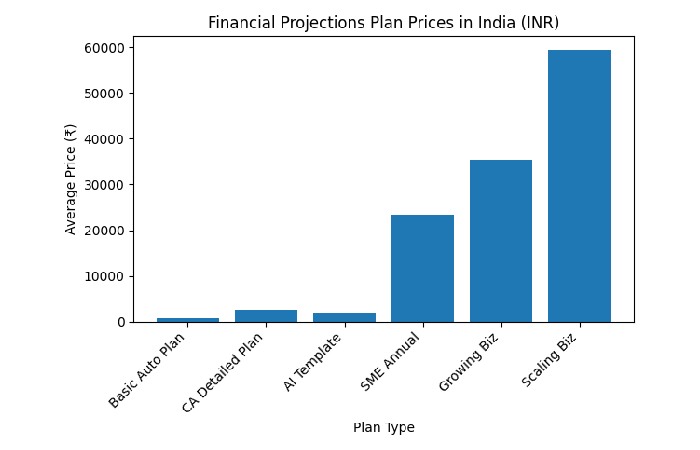
In India, the price for a Financial Projections Business Plan typically ranges from ₹500 to ₹3,000 for basic or automatic models, and from ₹10,000 to ₹60,000+ for full, consultant-prepared reports. Prices vary based on customization level, forecast years (3–10 years), and whether a CA or a financial consultant prepares it.
India
| Service Type | Example Plan / Package | Typical Price (₹) | What’s Included |
| Simple Project Report | Basic auto-generated projection | ₹399 – ₹999 | Profit & Loss, Cash Flow, Balance Sheet (up to ~7 years) |
| Detailed CA-Prepared Report | Expert CA project report | From ~₹2,499 | Customized projections (up to 10 years) + charts & ratios |
| AI Business Plan Templates | BizPlan AI Pro India one-time | ₹299 – ₹3,499 (one-time) | Business plan + basic financial forecasts |
| Annual SME Accounting & Reporting | Basic business support bundle | ~₹23,460/yr | Includes periodical profit & loss, balance sheet reports |
| Growing Business Finance Plan | SME/Bookkeeping + Reports | ~₹35,460/yr | More reporting & reconciliation services |
| Scaling Business Plan Services | Full reporting + monthly recon | ~₹59,460/yr | Monthly P&L, balance sheet, and magazine reports |
| Financial Consultant / Expert Project | Custom financial projections | ₹50,000 – ₹2,00,000 (one-time) | Consultant builds tailored 3-5 yr estimates; includes molds & account (approx. based on industry mentor rates and one-time planning fees in India) |
UK, USA, and London
| Region | Typical Price Range for Financial Projections (Basic Plan) | Advanced / Investor-Ready Plan | Notes |
| India | $50 – $200 | $250 – $600 | Lower cost due to freelance & small consultancy rates |
| United Kingdom | $180 – $500 | $600 – $1,500 | Pricing varies by firm and industry difficulty |
| United States | $200 – $700 | $800 – $2,500 | Higher rates for CPA/financial advisor models |
| London | $250 – $800 | $1,000 – $3,000 | Premium accessing market and startup system |
Is it the Same as a Projected Financial Statement?
According to the chapter Financial Analysis with Accounting Information, when you create a financial projection. You determine the flow of money by projecting your business’s financial position and results.
This means that when doing so. Financial statements that address these issues must be extrapolated, an aspect also highlight in the Financial Encyclopedia. Which establishes that concluding financial remarks consists precisely in calculating which ones the company will present in the future.
For this reason, we agree that the projected financial statements are necessary to realize a financial projection.
Finally, we recommend that you consider your forecasts’ reasonable and realistic nature. For this reason, it is ideal that they are present with an explanatory report of the initial hypotheses propose by the model so that it is possible to check their consistency.
Perfect! You already know the benefits of a sound financial forecast and how to prepare it accurately and correctly.
Consider these tips and increase the profitability of your business.
Conclusion
A financial projection tool allows companies to analyze historical and current performance to plan future expenses, income, and investments. So you know where your business can go and what adjustments need to be made to keep growing.
The idea is that you know a company’s financial situation by studying and interpreting the numbers. Which should be part of a solid business plan. The intention is that it can represent specific scenarios that your business is likely to face. So be prepare for the positives and negatives.
