
Fahmeena creates clear and practical content across digital marketing, technology, business growth and emerging digital trends.

Sameena reviews digital content for clarity, factual presentation, consistency and overall reader usefulness.
Introduction
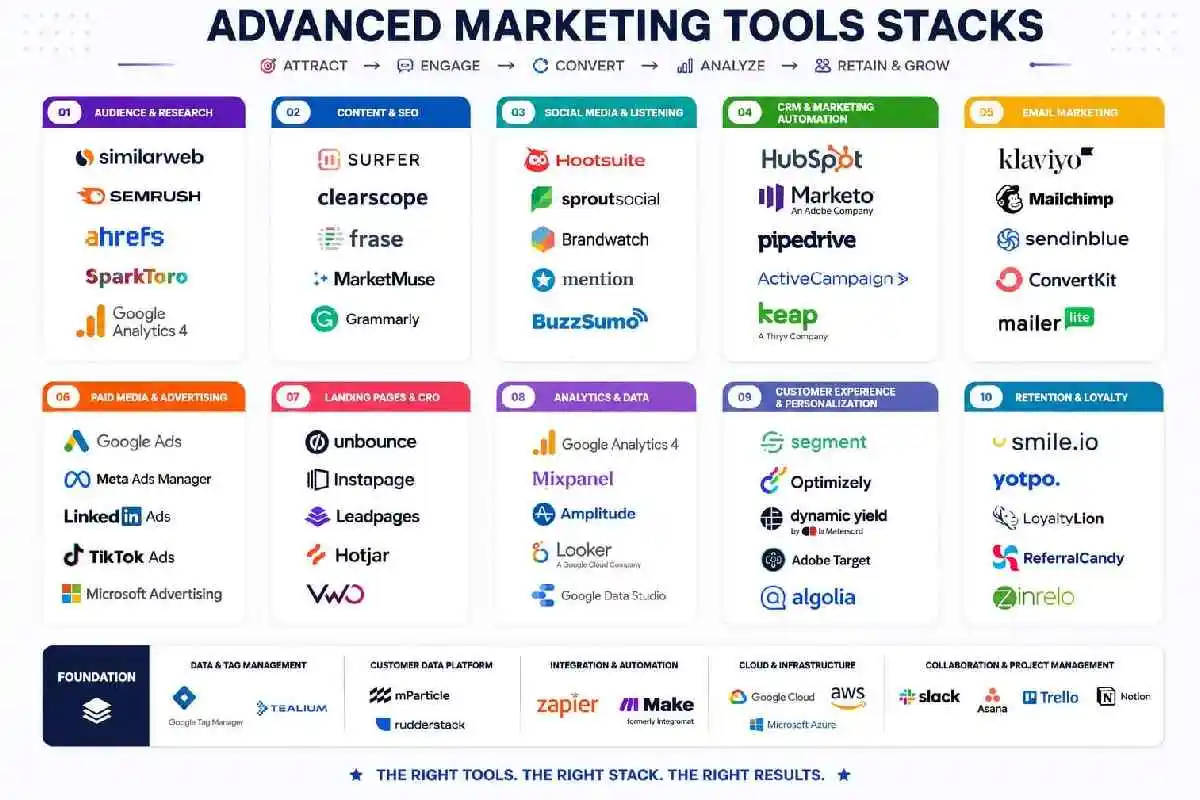
Today, Advanced Marketing Tool Stacks are absolutely necessary for all those businesses that wish to survive in the digital age in 2026. Modern-day marketers leverage digital marketing technologies and tools as SEO tools, automation tools, analytics platforms, CRM systems, and other software tools and platforms to facilitate better management of their campaigns. With an advanced and effective digital marketing stack, businesses will be able to benefit from better productivity, tracking of customer behavior, workflow automation, and higher conversions.
Building an efficient marketing ecosystem often starts with a comprehensive digital marketing tools collection that supports multiple channels and workflows.
📈 This article is part of our
Digital Marketing Tools
What Is an Advanced Marketing Tool Stack?
An advanced marketing tool stack is a set of integrated software platforms used by marketers to manage:
- SEO
- Content marketing
- Social media
- Paid advertising
- Email campaigns
- CRM management
- Analytics and reporting
- Automation workflows
- E-commerce optimization
Why Marketing Tool Stacks Material in 2026
Modern businesses track their marketing campaigns across numerous stages. An advanced marketing stack will assist marketers to:
| Benefit | Impact on Business |
| Automation | Saves manual work |
| Data Integration | Better customer insights |
| AI Optimization | Improves campaign performance |
| Workflow Efficiency | Faster execution |
| Multi-Channel Tracking | Accurate attribution |
| Scalability | Supports business growth |
Organizations frequently connect social media marketing tools with other platforms to streamline content publishing and audience engagement.
Complete Digital Marketing Tech Stack Guide
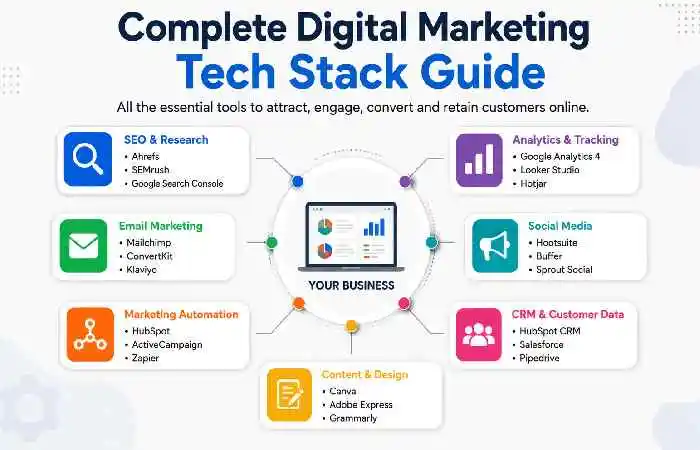
The following elements are to be included in an all-embracing tech stack, namely: SEO-related software, content marketing tools, email marketing, customer relations management systems, data analytics tools, and social media scheduling services.
Companies have started to depend on Google Analytics 4, HubSpot, Ahrefs, Mailchimp, and Zapier to enhance the effectiveness of their marketing processes as well as marketing campaigns. The future in 2026 is all about marketing stacks that will enable automation of marketing processes and analysis of consumers’ behaviors.
Many businesses connect email marketing tools with customer data platforms to improve campaign automation.
Core Components of a Marketing Stack
SEO Tools
SEO tools help trades improve organic searchability.
Popular SEO platforms include:
- Ahrefs
- SEMrush
- Google Search Console
- Screaming Frog
- Surfer SEO
CRM Tools
CRM platforms organize leads and customer interactions.
Common CRM software:
- HubSpot
- Salesforce
- Zoho CRM
- Pipedrive
Email Marketing Platforms
Email robotics tools help nurture principals.
Top platforms include:
- Mailchimp
- ConvertKit
- ActiveCampaign
- Klaviyo
Analytics & Tracking
These tools display website traffic and changes.
Popular choices:
- Google Analytics 4
- Looker Studio
- Hotjar
- Microsoft Clarity
Automation Platforms
Automation tools connect apps and workflows.
Examples include:
- Zapier
- Make
- HubSpot Workflows
- n8n.
Best Marketing Tools for Agencies
Marketing agencies have software that helps them in managing their clients’ campaigns and reports, SEO tracking, collaboration between staff, and reporting. The software that marketing agencies prefer using includes Hubspot, SEMrush, Ahrefs, Clickup, and Looker Studio since they help them manage more than one client at once and allow workflow automation. By 2026, marketing agencies will depend greatly on their marketing stacks.
Comprehensive reporting becomes easier when advanced systems include analytics and tracking tools that centralize performance metrics.
Essential Agency Marketing Stack
| Tool Category | Recommended Tools | Best For |
| SEO | Ahrefs, SEMrush | Keyword study |
| Reporting | Looker Studio | Client dashboards |
| Project Management | ClickUp, Trello | Team collaboration |
| Automation | Zapier, Make | Workflow automation |
| Social Media | Buffer, Hootsuite | Scheduling |
| CRM | HubSpot, GoHighLevel | Lead management |
Why Agencies Favor Integrated Stacks
Agencies work with massive amounts of data related to campaigns. It is aided by integrated stacks, such as:
- Reduced Manual Reporting
Automated dashboards eliminate the need for repetitive work.
- Improved Client Communications
With CRM additions, tracking becomes easier for customer infrastructures.
- Scalability
Automation helps activities serve more clients with limited resources.
Marketing Automation Workflow Tools
The marketing automation workflow tools can enable the business organization to automate repetitive tasks that include email campaigns, nurturing leads, follow-up with customers, and scheduling on social media. Tools and applications such as HubSpot, Zapier, ActiveCampaign, and Make are some examples of marketing automation tools where marketers can integrate different applications to create effective automated workflows. Automation is an important process in 2026 for marketers as it helps increase productivity and conversion rates of their marketing campaigns.
Many marketers begin experimenting with stack development using free digital marketing tools before upgrading to enterprise solutions.
Popular Marketing Automation Workflows
Lead Capture Automation
Visitor fills out the form → CRM captures lead → Automatic email sequence begins.
E-commerce Automation Workflow
Customer leaves products in the cart → Reminder Email is triggered → Discount email offer is sent.
Social Media Automation
Blog post created → Automatically posted on various platforms.
Best Automation Platforms Compared
| Platform | Best Use Case | Beginner Friendly | AI Features |
| Zapier | App integrations | Yes | Moderate |
| Make | Advanced automation | Medium | Moderate |
| HubSpot | Full marketing automation | Yes | Strong |
| Active Campaign | Email automation | Yes | Strong |
| n8n | Developer workflows | Advanced | Flexible |
Tools Used by Professional Digital Marketers
It is achieved using know-how that originates from various fields, such as SEO, analytics, mechanization, and content formation. The tools comprise Ahrefs, SEMrush, Google Analytics 4, HubSpot, Canva, and Zapier. These are just a few of the advanced marketing tools available for marketers to make use of and save themselves some time.
Many advanced setups include powerful SEO tools for marketers to manage keyword research, audits, and search optimization at scale.
Example of Common Professional Marketing Stack
SEO & Content
- Ahrefs
- Surfer SEO
- Google Trends
Analytics
- GA4
- Looker Studio
- Hotjar
Content Creation
- Canva
- Adobe Express
- ChatGPT
- Grammarly
Advertising
- Google Ads
- Meta Ads Manager
- LinkedIn Campaign Manager
Automation
-
- Zapier
- HubSpot
- Klaviyo.
Businesses with regional audiences often connect local SEO and business tools to improve local search visibility and customer acquisition.
Best Digital Marketing Tools for E-commerce Stores
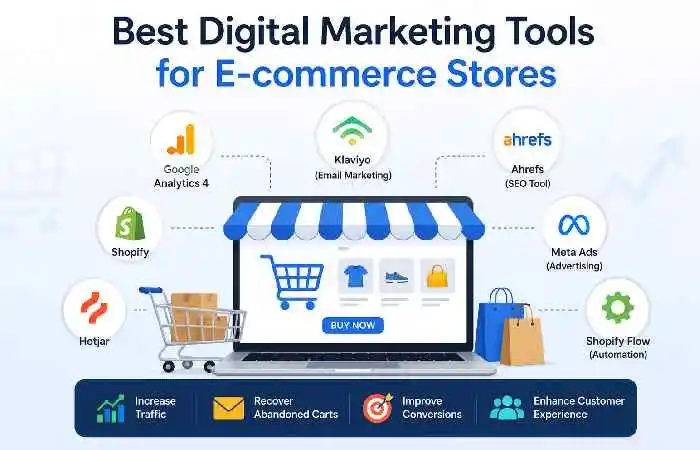
But then some marketing tools might be used in order to guarantee the success of an e-commerce business through optimizing its online presence, automating interactions, and improving conversion rates. Some of the marketing tools that are currently being used by most e-commerce businesses include Shopify, Klaviyo, Ahrefs, Google Analytics 4, and Hotjar.
These sorts of marketing tools have been helpful for e-commerce businesses in recovering losses, promoting themselves more effectively, and also improving their product pages’ performance. It is anticipated that in the year 2026, AI-driven marketing tools will play a very crucial role in e-commerce.
Performance-driven organizations frequently integrate PPC and advertising tools into their technology stack for campaign management and optimization.
Recommended E-commerce Marketing Stack
| Marketing Need | Recommended Tool |
| Email Marketing | Klaviyo |
| Store Analytics | Triple Whale |
| SEO | Ahrefs |
| Conversion Optimization | Hotjar |
| SMS Marketing | Postscript |
| Automation | Shopify Flow |
| Reviews | Judge.me |
Why E-commerce Brands Need Advanced Stacks
Modern online stores compete aggressively on customer experience and personalization.
Advanced stacks help businesses:
-
- Recover abandoned carts
- Increase repeat purchases
- Improve upselling
- Track customer lifetime value
- Automate customer journeys.
Content teams benefit from integrating content marketing tools that simplify planning, creation, and content distribution.
Conclusion
There is nothing optional about having an Advanced Marketing Tool Stack by 2026. Companies that incorporate SEO, automation, analytics, CRM, and AI-powered processes will have many benefits.
If you are a business owner, marketer, or work for an agency, then creating an ideal stack of marketing tools can help you get ahead with your campaigns and improve results. Remember, the process should be easy yet efficient.
Modern marketing stacks often incorporate AI-powered marketing tools for automation, predictive analytics, and workflow optimization.
Fahmeena Begum is a Digital Marketing & Technology Writer at Web Digi Marketing with 3+ years of writing experience. Her work covers digital marketing, SEO, content marketing, business growth, digital tools, artificial intelligence, software and emerging technologies.
View Author Profile →
Sameena Begum is a health, technology and digital content reviewer with 8 years of experience. Her review work focuses on editorial clarity, factual presentation, consistency and reader usefulness across technology and digital subjects.
View Reviewer Profile →