


Last Updated: August 13, 2026
Definition
SEO results can be hard to achieve if your content is published without proper planning. SEO Content Strategy Services are aimed at creating the content that corresponds to user intentions and helps to accomplish your company goals, as well as increase your organic SEO. Unlike random keyword hunting, a successful strategy will establish your authority via content clusters, good-quality content, and ongoing optimizations. Regardless of whether you are a startup or an existing business, the strategy will provide sustainable organic growth.
Looking for a complete content marketing solution? Explore our SEO content marketing services to improve organic visibility and attract qualified traffic.
🔧 This article is part of our
SEO Content Hub
What Is an SEO Content Strategy?
SEO content strategy is a written plan that establishes what kind of content needs to be developed, why it is required, for whom it is done, and how this content helps in achieving search engine visibility. Unlike the creation of separate blog posts, this content is built around interconnected topics, which increases topical authority.
Once you have a strategy in place, effective execution starts with quality SEO content writing services that align with your search and audience goals.
The process includes many things: from keyword research and analysis to measuring the performance of your content.
Core Elements of an SEO Content Strategy
| Element | Purpose |
| Keyword Research | Identify valuable search opportunities |
| Search Intent Analysis | Match content to user expectations |
| Topic Bunches | Figure topical authority |
| Internal Linking | Advance crawlability and page authority. |
| Content Calendar | Maintain publishing consistency |
| Performance Tracking | Measure SEO success |
Audience and Search Intent Research

SEO optimization process begins with identifying your target market and determining the reasons for which they should search. The details of your target market and the factors motivating them to conduct searches will help you know the right keywords to employ.
Consistent publishing can strengthen your strategy over time, so explore our SEO blog content services for engaging, search-optimized articles.
Identify Your Target Market
You need to learn everything about your target market in order to create useful content. Think of your industry, your business, your target demographic, problems, and buying patterns before creating any content.
Important audience research points:
- Create your customer personas.
- Get to know the common issues and goals of your customers.
- Know the demographics and interests of your customers.
- Find out your competitor’s target audience.
- Get valuable information from your customer feedback and analytics.
Understanding Search Intent
Search intent is the reason for which a user searches. If your content matches the right search intent, then there is a greater chance of your site being ranked.
Main types of search intent:
- Informational: The operator wants to learn something or get an answer.
- Commercial: The employer compares different products or services to make a decision.
- Transactional: The operator is ready to buy or ask for a particular service.
- Navigational: The operator searches for an exact website, brand, or web page.
Investigate User Behavior
User behavior analysis is a key part of your SEO strategy because it allows you to gather useful information.
Methods for User Behavior Analysis:
- Watch the number of page views and engagement.
- Watch bounce rate and time spent.
- Identify successful landing pages.
- Analyze on-site search queries.
Topic Cluster Development
Topic clusters are an SEO technique where content is grouped based on a particular topic in order to help search engines understand how expert you are in that topic. Creating topic clusters entails linking supporting articles via relevant internal links to build topical authority and help search engines comprehend the subject matter more clearly.
If conversions are a key part of your content goals, our SEO copywriting services can help turn organic visitors into potential customers.
| Topic Cluster Element | Purpose | Example |
| Pillar Page | Covers the main topic in depth | SEO Content Strategy Services |
| Cluster Articles | Explore specific subtopics in detail | SEO Content Writing, Keyword Research, Content Gap Analysis |
| Internal Linking | Attaches pillar and cluster pages to distribute authority | Connect each cluster article back to the pillar page and related clusters |
| Primary Keywords | Target high-volume, broad search terms | SEO Content Strategy |
| Secondary Keywords | Capture long-tail and related searches | Content planning framework, topic clusters, search intent research |
| Content Updates | Keep cluster pages accurate and relevant | Refresh statistics, examples, and internal links regularly |
| User Journey Mapping | Guide visitors from learning to conversion | Informational blog → Service page → Contact page |
Content Planning Framework
A properly established content planning framework guarantees that all pieces of content contribute to your SEO objectives and business objectives. A content planning framework helps in prioritizing topics, maintaining publishing consistency, and developing content that meets user search intent.
For organizations serving business audiences, explore our B2B SEO content marketing services to create content aligned with complex buyer journeys.
Keyword Mapping
Give one key term and a series of related secondary key terms for each web page in order to prevent cannibalization. Keyword mapping assists search engines in understanding what the piece of content is about.
Editorial Calendar
Produce a publication schedule that plans topics to be published, limits, team members involved, and when announcements will happen. The journalistic calendar safeguards consistency and excellence of content.
Content Optimization Process
Produce a process for researching, writing, editing, optimizing, publishing, and updating content.
| Framework Stage | Key Activities | SEO Benefit |
| Research | Keyword research, audience analysis, entrant review | Boards have valuable search opportunities |
| Planning | Matter selection, content briefs, keyword mapping | Makes a structured content strategy |
| Content Creation | Writing educational, user-focused content | Recuperates relevance and appointment |
| On-Page Optimization | Improve titles, headings, meta descriptions, and internal relatives | Recovers search discernibility |
| Publishing | Evaluation, publish, and index content | Safeguards timely content delivery |
| Performance Monitoring | Path rankings, traffic, and conversions | Classifies opportunities for improvement |
| Content Refresh | Inform outdated information and optimize existing pages | Upholds rankings and topical authority |
Content Gap Analysis
A Content Gap Analysis helps you to find out which topics/keywords/content gaps rank for your competitors but not for you. This type of content gap could be found by you and could leverages to create strategic content that fills gaps and brings organic traffic to you.
To understand whether your strategy is delivering meaningful results, learn more about SEO content marketing ROI and how to measure content performance.
Why is Content Gap Analysis Important?
Regular content gap analysis will help you stay ahead of your competitors and make sure all the themes that your target audience is searching for represent on your website. Moreover, such gaps will enable you to detect outdated content that needs optimization to increase its ranking and conversion rates.
How to Conduct Content Gap Analysis?
First, audit your current content against high-ranking competitors’ content. Discover keywords that are absent from your content, user questions, and gaps you have to fill.
Sample Gap Analysis
| Content Area | Current Status | Opportunity |
| Beginner Guides | Strong | Maintain |
| Service Pages | Moderate | Expand |
| Case Studies | Weak | Create |
| Industry Pages | Missing | High Priority |
| FAQs | Limited | Improve |
Measuring Strategy Success
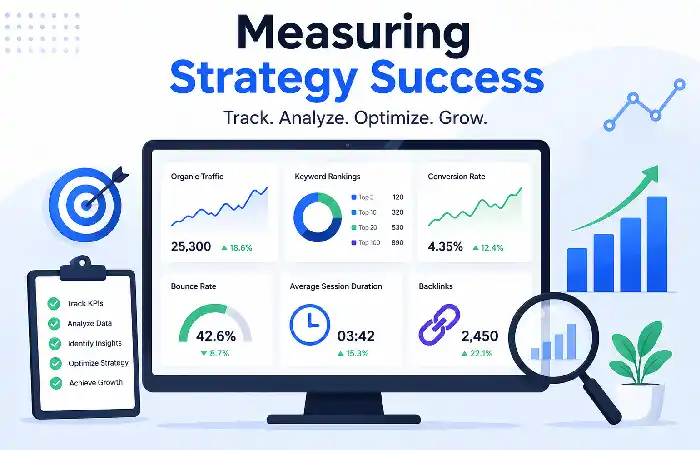
Measuring the success of SEO content strategy can tell you whether what you have been doing is really helping your business. It is important not to focus solely on keyword rankings, but rather to monitor the traffic, appointments, and changes in your satisfaction in order to find out how your efforts translate into value and identify areas for development.
| KPI | What It Measures | Why It Matters |
| Organic Traffic | Number of visitors from search engines | Indicates overall SEO discernibility and growth |
| Keyword Rankings | Spots of target keywords in search results | Measures improvements in search performance |
| Click-Through Rate (CTR) | Fraction of users clicking your search listing | Imitates the effectiveness of titles and meta descriptions |
| Conversion Rate | Percentage of visitors completing a desired action | Displays how well content supports business goals |
| Engagement Time | The regular time users spend on a page | Designates content quality and relevance |
| Bounce Rate | Section of users leaving after one page | Helps identify sheets that need optimization |
| Backlinks Earned | Number of quality websites linking to your content | Reinforces domain authority and trust |
| Indexed Pages | Number of pages indexed by search engines | Authorizes that valuable content is discoverable |
| Internal Link Performance | Worker interaction with internal links | Advances navigation and distributes page authority |
| Content ROI | Income or leads generated compared to content investment | Actions affect the overall efficiency of your SEO content strategy |
Conclusion
Therefore, an SEO content strategy is not only about writing blog posts. It is about building a system where all these notions – related to user intent, keyword analysis, content clustering, internal linking, and the analysis of the performance of your content – will act together to build one growth machine. Using E-E-A-T principles, building a content strategy system, and finding the content gaps will give you topical authority and conversions.
FAQS
What is an SEO content strategy?
SEO content strategy means the creation, organization, publication, and optimization of the content, considering user intent and company objectives.
How often does an SEO content strategy need refreshing?
The SEO content strategy should check out quarterly and refreshed in a six-to twelve-month period or when some changes occur in search trends, algorithm, and company objectives.
What is the difference between content marketing and SEO content strategy?
The point of content marketing is the creation and distribution of the content, and the SEO content strategy is the one that is concerned with improving visibility through the use of keywords and user intent.
Why is it important to create topic clusters for SEO?
The reason why topic clusters are so important is that they make connections between the content and show search engines that you are an expert in particular fields.